SWEDEN - POLITICS

Sweden is a constitutional monarchy, in which King Carl XVI Gustaf is head of state, but royal power has long been limited to official and ceremonial functions. The Economist Intelligence Unit, while admitting that democracy is difficult to measure, lists Sweden in first place in its index of democracy assessing 167 countries. The nation’s modern legislative body is the Riksdag (Swedish Parliament), with 349 members, which chooses the Prime Minister. Parliamentary elections are held every four years, on the third Sunday of September.
SWEDEN - HISTORY

Sweden’s prehistory begins in the Allerød warm period c. 12,000 BC with Late Palaeolithic reindeer-hunting camps of the Bromme culture at the edge of the ice in what is now the country’s southernmost province. This period was characterised by small bands of hunter-gatherer-fishers using flint technology.

Between the eighth and eleventh centuries BC come the Swedish Viking Age.

SWEDEN - ECONOMY

Sweden is a highly industrialized country. Agriculture, once accounting for nearly all of Sweden’s economy, now employs less than 2% of the labour force. Extensive forests, rich iron ore deposits, and hydroelectric power are the natural resources which, through the application of technology and efficient organization, have enabled Sweden to become a leading producing and exporting nation.

SWEDEN - BASIC FACTS

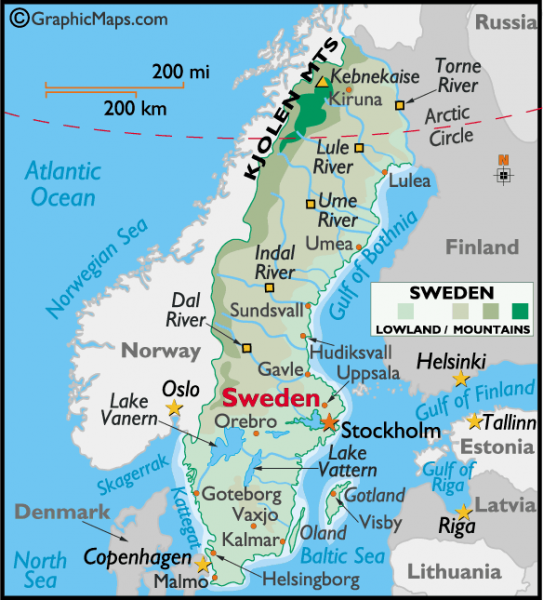
Sweden, officially the Kingdom of Sweden (Swedish: Konungariket Sverige) is a Nordic country on the Scandinavian Peninsula in Northern Europe. It has borders with Norway (west and north) and Finland (northeast). Sweden joined the European Union on January 1, 1995. Its capital is Stockholm.

Sweden

Land area: 158,927 sq mi (411,621 sq km); total area: 173,731 sq mi (449,964 sq km)

UNITED KINGDOM - COMMUNICATION

The British are said to be reserved in manners, dress and speech. They are famous for their politeness, self-discipline and especially for a sense of humour. Basic politeness (please, thank you, excuse me) is expected.

British people are quite reserved when greeting one another. A greeting can be a bright ’Hello’ ’Hi’ or ’Good morning’, when you arrive at work or at school.

UNITED KINGDOM - CULTURE

Religion in Great Britain

The official religion in Britain is Christianity as practised by the Anglican Church. Followers of this branch of Christianity are known as Protestants and make up the majority of the population, although there are also many Catholics. Christians constitute about 71% of the population, but Britain is a multi-faith society and all other religions, including; Buddhism, Hinduism, Judaism, Islam and Sikhism are freely practiced. About 23% of Britain follows no particular religion.

UNITED KINGDOM - POLITICS

The main British parties support a strong transatlantic link, but have become increasingly absorbed by European issues as Britain’s economic and political ties to the continent grew in the post-Cold War world. Prime Minister Brown is expected to continue Blair’s policy of having the United Kingdom play a leading role in Europe even as the United Kingdom maintains its strong bilateral relationship with the United States. Britain’s relationship with Europe is a subject of considerable political discussion in the United Kingdom.