
Sweden
Sweden
SWEDEN - LANGUAGE PHRASES
Swedish is a North Germanic language, spoken by more than nine million people, predominantly in Sweden and parts of Finland, especially along the coast and on the Åland islands. It is to a considerable extent mutually intelligible with Norwegian and to a lesser extent with Danish. Along with the other North Germanic languages, Swedish is a descendant of Old Norse, the common language of the Germanic peoples living in Scandinavia during the Viking Era.
SWEDEN - TRAVEL AND TOURISM
Many people imagine Stockholm when speaking about Sweden but it is not the only place to go. All the nature, ice hotels, cities, boats and typical Swedish colour make Sweden the most thrilling experience out of all the northern countries of EU.
For further information look at www.visitsweden.com

SWEDEN - COMMUNICATION
Swedish society is a great example of tolerance and openness.
This nation is one of the more reserved within the EU. When you want to develop a conversation with a Swede, he or she will always first listen to you and then give you his or her opinion. Swedes do not interrupt each other while speaking which makes the business conversation very clear and well-organised.
SWEDEN - CULTURE
Over 80% of Swedes belong to the Lutheran Church of Sweden, but seldom go to church. Attendance is a bit higher among members of free churches such as Pentecostalists and the Salvation Army. Christenings, weddings and funerals are usually made in church, although civil weddings are generally accepted - especially for subsequent marriages. Around half of Swedes are confirmed, usually at the age of fifteen.
SWEDEN - POLITICS
Sweden is a constitutional monarchy, in which King Carl XVI Gustaf is head of state, but royal power has long been limited to official and ceremonial functions. The Economist Intelligence Unit, while admitting that democracy is difficult to measure, lists Sweden in first place in its index of democracy assessing 167 countries. The nation’s modern legislative body is the Riksdag (Swedish Parliament), with 349 members, which chooses the Prime Minister. Parliamentary elections are held every four years, on the third Sunday of September.
SWEDEN - HISTORY
Sweden’s prehistory begins in the Allerød warm period c. 12,000 BC with Late Palaeolithic reindeer-hunting camps of the Bromme culture at the edge of the ice in what is now the country’s southernmost province. This period was characterised by small bands of hunter-gatherer-fishers using flint technology.
Between the eighth and eleventh centuries BC come the Swedish Viking Age.
SWEDEN - ECONOMY
Sweden is a highly industrialized country. Agriculture, once accounting for nearly all of Sweden’s economy, now employs less than 2% of the labour force. Extensive forests, rich iron ore deposits, and hydroelectric power are the natural resources which, through the application of technology and efficient organization, have enabled Sweden to become a leading producing and exporting nation.
SWEDEN - BASIC FACTS
Sweden, officially the Kingdom of Sweden (Swedish: Konungariket Sverige) is a Nordic country on the Scandinavian Peninsula in Northern Europe. It has borders with Norway (west and north) and Finland (northeast). Sweden joined the European Union on January 1, 1995. Its capital is Stockholm.
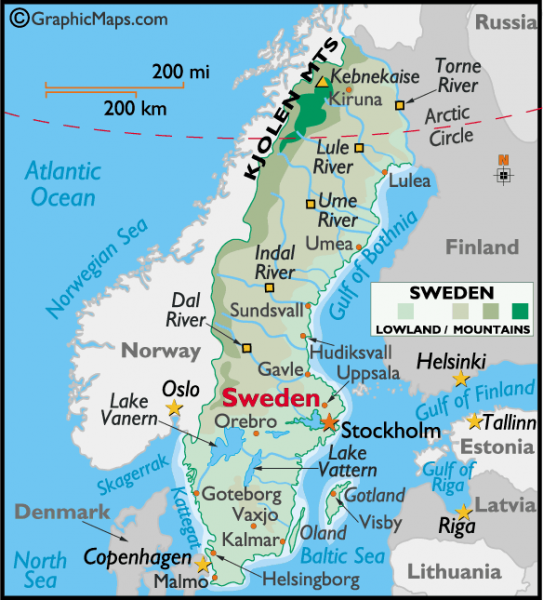
Land area: 158,927 sq mi (411,621 sq km); total area: 173,731 sq mi (449,964 sq km)