
Government system of Belgium is Constitutional Monarchy. Head of State and also main representative is a King of Belgium. However, true power lies in the hands of Prime Minister appointed by the King, Prime Minister is also head of the main political party in the country. Government is formed by representatives Valons and Flemings. Parliament consist of two Houses : Senate (181 members) and the House of Representatives (212 members). Belgian law is based on Civil Code supplemented by specific laws.
Belgium is a member of the following organizations: United Nations (UN), NATO, OECD (Organization of Cooperation and Development), GATT (General Agreement of Tariffs and Trade), EU, European Council, WEU (West European Union) and Benelux.
Head of state: Albert II. - King
Head of Goverment: Herman Van Rompuy (CD&V) - Prime Minister
Governing parties: CD&V, MR, VLD, CDH, PS, N-VA
Last national elections: 2007

http://www.parties-and-elections.de/belgium.html
Last European Parliament election June 2009
See:
http://en.wikipedia.org/wiki/European_Parliament_election,_2009_(Belgium)
http://www.europarl.europa.eu/parliament/archive/elections2009/en/belgium_en.html
Government
Federal government has 15 ministers and several secretaries of state. Its is forbidden to combine one of those functions with parliamentary mandate.
The current prime minister of Belgium is Yves Leterme from the Christian Democratic party. This party won the parliamentary election in 2007. To assemble the new Belgian government took nine months. It is based on coalition of five political parties.
Parliament
The two chamber Federal Parliament consist of the Senate and the House of Representatives. The Senate has 71 members appointed for 4 years. In addition, the King’s successor has the right to join the Senate. House of Representatives has 150 members chosen by election for 4 years. The authority of the Senate is limited. The main role of the Senate is to arbitrate between organs of federation.
Belgium has a proportional electoral system based on 11 districts. People over 18 years of age have the right to vote.
Political Parties
All traditional political parties (Christian Democrats, Socialists, Liberal Democrats and also Greens) exists independently in Valon and Fleming part of the country.

| Belgian Senate - source |

Administrative classification
Belgium is divided into three main regions and those are divided into10 provinces.
Regions: Brussels, Fleming region, Valon region
Provinces: Antwerp, Limburg, Fleming Brabant, East Flanders, West Flanders, Hainaut, Lutych, Luxembourg, Namur, Valon Brabant.
Belgium and European Union (EU)
- One of the founders of EU
- Since the beginning Belgium participated in integrative groupings (like establishment of ESUO –European Association of Coal and Steel)
- Belgium participated in evolution of European associations such as: European customs union and interstate marketing bodies
- In the middle of nineties Belgium strongly supported the EURO – EU currency
- Brussels is now capital city of the European Union and shares European parliament with the city of Strasbourg
- Presence of EU officials supports local business in Brussels and other parts of Belgium
- For a small country like Belgium, the central position in the EU is important for the formation of the Belgian international policy
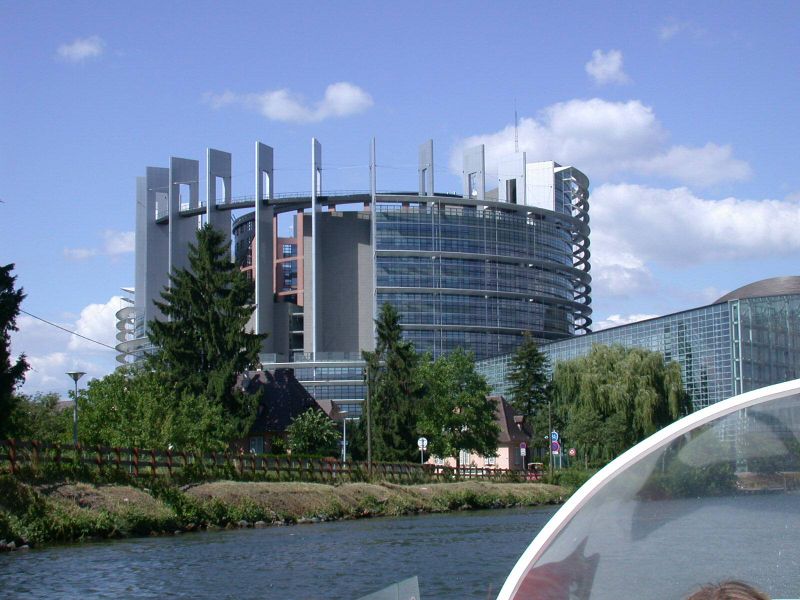
| European Parliament in Strasbourg - source |
